Proprietary Middleware – A Patchwork Instead of True Integration
The reality in many laboratories looks quite different from what vendors of proprietary middleware promise. Instead of a unified integration layer, parallel worlds often emerge: multiple middleware systems alongside direct device interfaces. Business logic—rules for orders, validations, or data processing—ends up distributed across different components. The result is fragmented processes, increased maintenance burdens, and growing complexity that becomes difficult to manage in the long term.
In addition, proprietary systems often allow only limited customization. New devices or functions usually can only be connected via the respective manufacturer—bringing costs, delays, and a clear dependency. This hardly qualifies as flexibility.
Practical Example: General Integration Platforms Reach Their Limits
A real-world example is Mirth Connect, a widely used integration platform in healthcare.
Originally developed for exchanging HL7 messages, Mirth is well suited for classic interfaces between IT systems, such as between HIS and LIS. However, it is not designed for the specific integration of laboratory devices: device control, bidirectional communication, or accessing device-specific functions are simply not part of its core concept.
In addition, there are current challenges related to licensing. While Mirth was long maintained in an open-source variant, newer versions are now available only as proprietary software. Laboratories that relied on this platform are suddenly faced with strategic decisions, such as whether to continue working with a frozen community version or switch to a paid model.
These examples illustrate why laboratories need a solution that was designed from the outset with a focus on devices—open, modular, and independent.
Open Source Middleware Specialized for Laboratory Devices
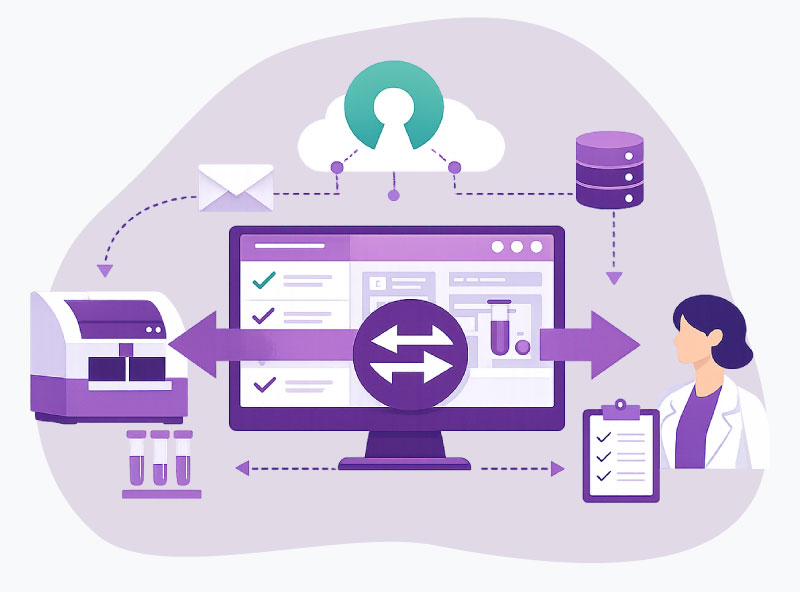
The medicalvalues Open Device Integration Service was developed with exactly this goal in mind: a middleware that seamlessly integrates laboratory devices while offering full flexibility.
Modern architecture: API-first, modular, and designed for high availability.
Full device functionality: Bidirectional communication enables not only data acquisition but also device control.
Open standards: Support for FHIR, HL7, and LOINC ensures interoperability with other systems.
Modular design: New device drivers can be added flexibly—without dependence on a single vendor.
Freedom Through Community
A key advantage lies in community-driven development. Laboratories can set priorities, contribute their own drivers, or reuse existing components. Knowledge is shared, developments are transparent, and solutions can be adapted by others. This creates an ecosystem that fosters innovation and benefits everyone involved.
This openness makes the medicalvalues Open Device Integration Service a sustainable alternative to proprietary solutions, which often slow innovation through licensing models and closed interfaces.
Practical Examples: Different Requirements, the Same Foundation
Small specialized laboratory: A laboratory specializing in hormone and metabolic analyses wants to connect a new analyzer that currently has no interface to the existing LIS. With the medicalvalues Open Device Integration Service, a custom driver can be developed quickly—initially in cooperation with the community, later tailored to the laboratory’s specific requirements. Integration succeeds without high additional costs and without waiting for the device manufacturer.
Large clinical laboratory: A university hospital operates a wide range of devices from different manufacturers. Until now, several middleware systems have been running in parallel, each covering only part of the device landscape. This leads to redundant processes and fragmented business logic. With our Open Device Integration Service, the laboratory can create a unified integration layer: all devices are connected via a central middleware, while still retaining the ability to extend drivers and logic internally as needed. Complexity decreases, flexibility increases.
These two scenarios show that the medicalvalues Open Device Integration Service is not tailored to a specific size or structure. What matters is openness: from single laboratories to maximum-care providers, everyone benefits from a clear, open architecture.
Managed Service: Openness with Professional Support
Not every laboratory wants to take responsibility for operating middleware in-house. For this case, our Open Device Integration Service is also available as a managed service:
24/7 support and updates ensure stable operation.
Validated processes ensure that regulatory requirements continue to be met.
No lock-in: Despite professional operation, the open architecture remains intact—the laboratory retains full freedom to make adjustments or take over operations itself at any time.
This allows medicalvalues to combine the advantages of open source with the operational reliability of an enterprise offering.
Conclusion
The integration of laboratory devices must not become a bottleneck in digital transformation. Proprietary middleware solutions or general integration platforms like Mirth quickly reach their limits—whether due to missing device-specific capabilities, fragmented logic, or licensing restrictions.
The medicalvalues Open Device Integration Service shows that there is another way: middleware specifically developed for laboratory operations, open and modular, supported by a community—and optionally operated with professional support. For small specialty laboratories as well as large clinical labs, this means fewer dependencies, greater flexibility, and an IT architecture that is truly future-proof.