


Open Device Integration

Connect any device. Own your data. Free yourself from middleware lock-ins.

open, connected, independant

Lab Connectivity

The medicalvalues Open Device Integration is the open-source middleware layer purpose-built for clinical laboratory device connectivity. While established vendors lock labs into expensive proprietary interfaces, our community-driven, FHIR-based connector gives any lab full control over its device architecture — at a fraction of the cost, and without dependency on a single manufacturer.

features

One open integration layer. Every device. No lock-in.

Open source core
 

No black boxes. No licence fees. Parser, mapping layer, APIs, configuration, and monitoring are all open source. Full transparency into how your data flows — and no vendor holding it hostage.

Plugin device drivers
 

New device live in days, not months. A modular plugin architecture supports manufacturer-specific commercial drivers where needed, and an open community driver library where available. Adding a device no longer means starting from scratch.

FHIR standard
 

Harmonised data across every system. FHIR as the integration standard eliminates data silos and enables real automation and interoperability — between devices, the LIS, and the wider hospital IT ecosystem.

Audit & security
 

Compliant by design, not by patch. Full logging, data flow monitoring, API versioning, and audit trails built in from day one. Meets the compliance requirements of a regulated medical environment without add-on modules.

Community drivers


The library grows with every lab. Community-contributed drivers reduce duplicated effort across the industry.
When a new analyser hits the market, the connector is likely already there. Contribute one, benefit from hundreds.

LIS integration
 

Clean data straight into your workflows. Connects directly with medicalvalues Lab Intelligence — feeding validated device data into sample management, quality control, and the reporting cockpit. Also works alongside existing LIS platforms.

before & after

What changes when you switch

today

  Open Device Integration

Architecture

  • Multiple middleware systems in parallel
  • One open connector layer for all devices

Data

  • Fragmented silos, inconsistent formats
  • FHIR-standardised, harmonised throughout

New device

  • New vendor negotiation, new project
  • New invoice
  • Plug in a community driver

Cost

  • Per-interface fees to each manufacturer
  • No licence fees
  • Self-hosted option free

Control

  • Vendor-dependent
  • Opaque
  • Fully transparent
  • Open source

Support

  • Tied to proprietary vendor SLAs
  • 24/7 support from medicalvalues

Ready to cut the middleware complexity?

Let’s map your current device landscape and show you what a cleaner architecture looks like.

cloud or on-prem

Deploy your way

Choose the model that fits your infrastructure.
Both options include 24/7 support, regular updates, full audit trails and access to the community driver library.

Cloud hosted

fully managed

medicalvalues hosts, monitors, and maintains everything. Monthly updates, proactive monitoring, zero infrastructure overhead.

On-premises

self-hosted

Deploy in your own environment at zero licence cost. Full control over your data and infrastructure — your rules.

medicalcalues modules

Perspectives beyond the Open Device Integration

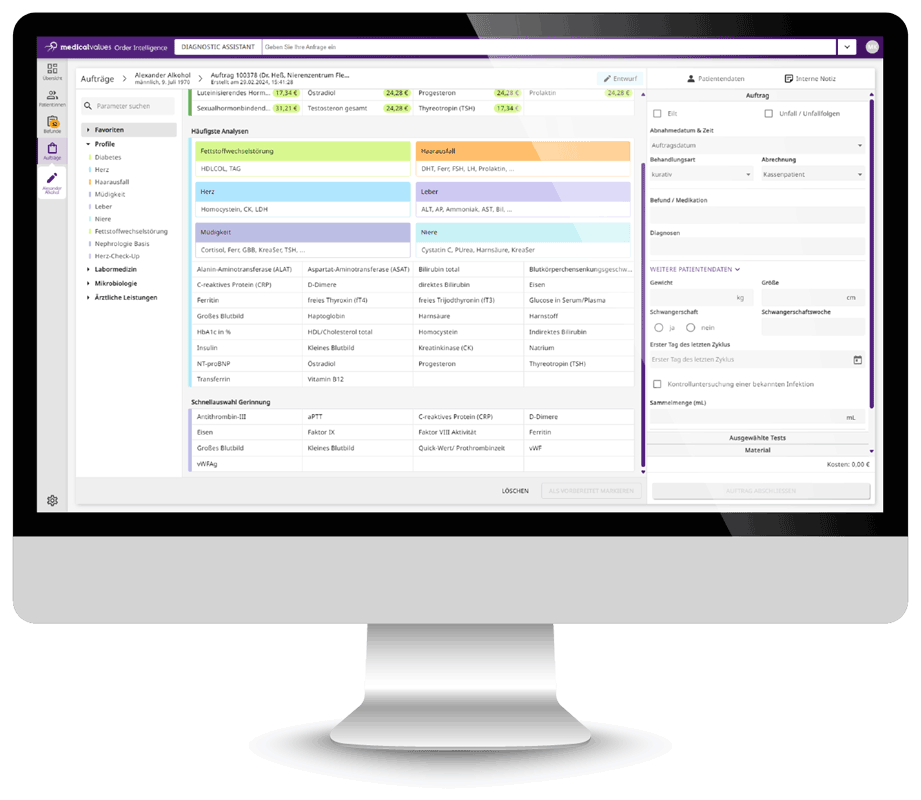
The medicalvalues Open Device Integration is just one component of the medicalvalues Platform. It can be optimally combined with the applications of the Data Management and Harmonisazion modules as well as the Order Intelligence.

Using the Open Device Integration, the medicalvalues applications can be used to create a central orchestration hub for orders, results, and master data. Thanks to the modular structure it is easy to connect channels such as order entry, portals, POCT, ePA/KIM, reporting apps, manual capture, and telephone-based workflows.

Recent News

The Laboratory Report of the Future: Interoperable, Understandable, Interactive and Actionable

Laboratory reports are among the most important sources of information in healthcare. They support diagnoses, accompany therapies, enable monitoring over time, and provide an objective basis for medical decisions. Laboratories already do far more than simply deliver measurements: they ensure analytical quality, assess plausibility, account for methodology and pre-analytics, provide interpretive guidance, and support clinicians in contextualising complex questions.

Read More »