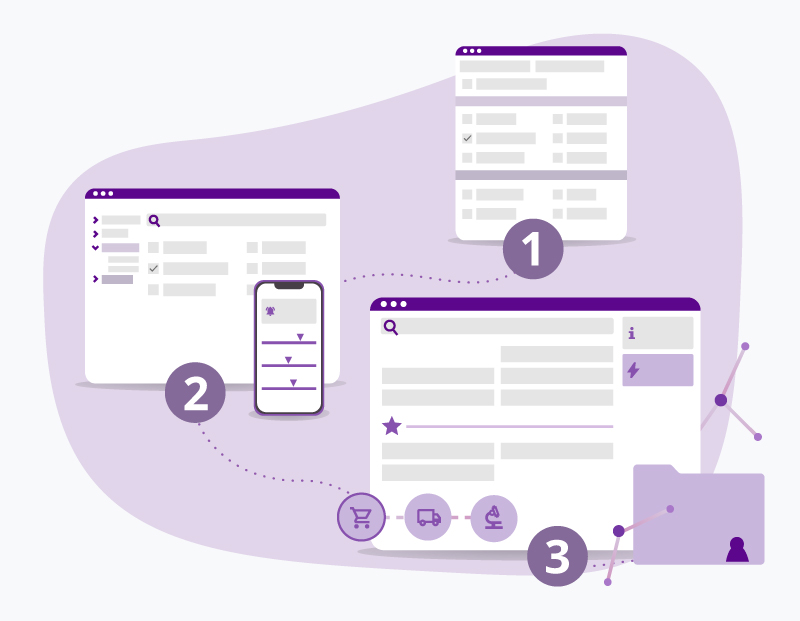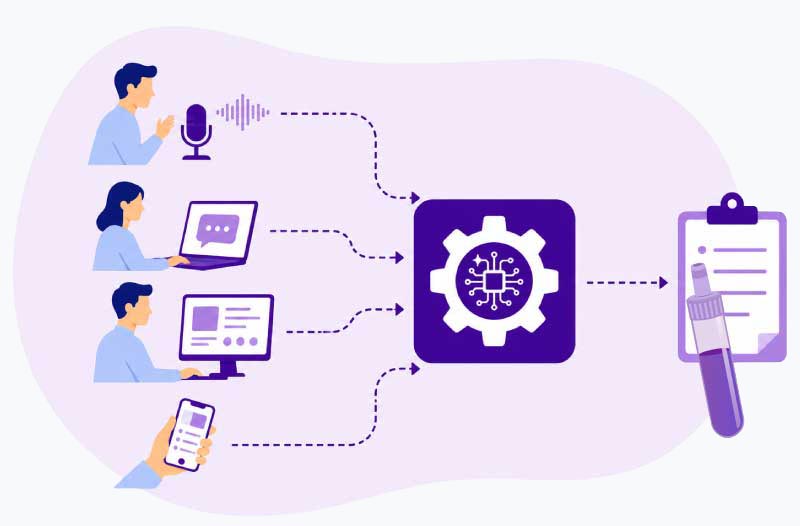
At a trade fair a few years ago, we showed something that felt almost like science fiction at the time: instead of ticking boxes in a request form, we simply told an assistant which laboratory test we needed – first by text, later by voice, directly within the application. The agent understood, asked sensible follow-up questions, and assembled the request. The reaction at the booth was always similar: first amazement, then the question, “And this really works?”
Yes, it works. And at the same time it raises a fundamental question that reaches far beyond a nice demo: if I can simply talk to a system – why do I still need an interface at all? The answer leads straight into an architectural debate that is currently returning with full force: the topic of “headless”.
What “headless” actually means
The term sounds more technical than it is. In software architecture, “headless” describes the decoupling of backend and frontend. The backend – the data, the functions and the logic of an application – is separated from the “head”, the user interface. Instead of hard-wiring logic and interface together, the system makes its capabilities available through defined interfaces. The “head” thus becomes interchangeable: the same functionality can appear in a web interface, a mobile app, a chat, a voice assistant, or directly within another system.
The idea is not new. Its first major appearance was in e-commerce. “Headless commerce” separated the shop frontend from the actual commerce engine in order to deliver products and ordering processes across any channel – website, app, marketplace, social networks. After a phase of disillusionment, the concept is now back, and with new urgency. The trigger is AI agents and the Model Context Protocol (MCP), an open standard through which agents can access external systems, tools and data in a structured way.
How serious the trend is can be seen in a prominent example from spring 2026: with “Headless 360”, Salesforce opened up practically its entire platform as an API, an MCP tool and a CLI command – with more than 60 new MCP tools through which AI agents access data, workflows and business logic directly. The browser becomes optional. One detail is worth noting, because it will matter shortly: the agents inherit the existing permissions, field-level security and sharing rules. Opening up to the outside therefore does not come at the expense of governance and control. Suddenly the “head” is no longer just another interface, but an autonomous agent that speaks to the backend in natural language.
Why this matters especially for physicians
The bridge to order entry is quickly built – and it begins with the users. Physicians do not want to work in yet another separate program. They want to stay where they already are: in the hospital information system (HIS) or the practice management system (PMS). Every additional system switch, every renewed login, every duplicate data entry costs time, attention and acceptance.
This is precisely where a headless-minded architecture plays to its strengths. If the request logic is decoupled from the frontend, order entry can be brought to where the work happens, instead of pulling users over to it. The “head” can be a native plugin in the HIS, a lightweight integration into the PMS, a mobile application – or an agent that takes a request in chat or by voice. Ordering laboratory diagnostics in conversation with an assistant, as in our trade-fair demo, is therefore not a gimmick, but another legitimate route to the same domain logic.
The lesson from the MS-DOS era
For all the enthusiasm, a look back is worthwhile. Anyone who has been around long enough remembers the command line. Under MS-DOS, you had to know what to type – the exact command, the correct syntax, the right parameter. If you did not know the command, you were stuck. The graphical interface that followed was not just prettier; its real progress lay elsewhere: it guided. Menus showed what was possible, dialogs asked for the right information in the right order, and nonsensical entries were prevented.
Modern AI and natural language feel, at first, like a return to “just say what you want” – and that is an enormous advantage. The barrier to entry drops, the interaction becomes faster and more intuitive. But pure chat also shares a weakness with the old command line: it assumes I know what to ask for. A good interface, by contrast, guides me through the process – precisely when I do not know exactly which test makes sense in which constellation. The art lies not in playing one against the other, but in combining both strengths.
The fallacy: headless is not simply “an API”
This is where the biggest misunderstanding arises. Headless is often equated with “we provide a few interfaces”. But an API that passes data in and out is only half the truth. Order entry is not merely a form on top of a database. Between data entry and data storage lies substantial domain logic, and that is where the real value sits:
-
Intelligent guidance through the process – depending on the clinical question, the sample material and the clinical context.
-
Reflex testing rules – for example: which follow-up parameter is triggered automatically, under which conditions and within which time window?
-
Prompts about parameters already determined – to avoid duplicate testing and unnecessary costs.
-
Constellation- and question-specific recommendations – which parameters are informative together and which really matter for a given clinical question.
-
Discipline-specific functions – such as markings and workflows in pathology, or integrated diagnostic support.
Anyone who thinks of headless as a bare API tears out precisely this intelligence and leaves only the plumbing behind. The result would be a fast but blind ordering channel – technically elegant and clinically mindless.
There is also the aspect already hinted at in the Salesforce example: governance. In a medical setting in particular, permissions, roles, traceability and data protection must not depend on the channel. Whether a request originates via the interface, a HIS plugin or an agent – the same rules, approvals and audit logs must apply. A headless-minded architecture must therefore carry this control with it, not surrender it.
The technical truth: the logic sits between database and interface
An application does not consist only of a database and an interface. In between sits the business logic – and it is precisely this that determines the quality of a request. Correctly understood, headless therefore means making not the data but the capabilities available through the interface: the rules, the checks, the recommendations, the guidance.
The gain is then considerable. Every “head” – whether guided interface, HIS plugin or AI agent – draws on the same validated domain logic. The reflex testing rule applies in the chat just as in the form. The prompt about a parameter already determined appears in the voice dialog just as in the app. Diagnostic quality is thus preserved regardless of the channel through which the request arises.
The future is hybrid
None of this leads to an either/or. The realistic and, in our view, desirable future is hybrid: agents and systems interlock. For standardized, complex or explanation-heavy processes, a good interface reliably guides through the process. For fast, obvious requests or for entry via natural language, an agent takes over – in chat, by voice, embedded in the HIS or PMS.
The decisive point is that both are fed from the same core. The agent is then not a foreign body alongside the system, but another, equally valid route to a shared, clinically reliable foundation. The interface does not disappear – it recedes into the background where language is faster, and stays present where guidance is needed.
Outlook: the platform makes the difference
For this hybrid interplay to succeed, two preconditions are needed – and both lie beneath the surface. The first is cleanly structured, harmonized data. Standards such as LOINC, SNOMED CT and FHIR are not an end in themselves; they are the condition for an agent to reliably understand what is being requested, and for rules and recommendations to apply consistently across all channels. Where data is inconsistently coded, even the most elegant interface remains unreliable. The second precondition is a modern, decoupled architecture: loosely coupled services, open interfaces, and a business logic that is deliberately separated from the frontend and remains reachable through every channel – interface, HIS/PMS, agent.
This is exactly what our AI diagnostic platform is built for. It is designed from the ground up so that the same validated diagnostic logic is not tied to a single interface, but is available to every route of access – the guided application as well as native integration into the HIS or PMS and the AI agent. Structured data and modern architecture are not an afterthought here, but the foundation. For us, headless is therefore not a retrofit, but a property of the platform.
Conclusion: headless yes, mindless no
Headless is not a buzzword, but a real and well-founded trend. For order entry in the laboratory, it opens up the chance to integrate in a modern, native way into HIS and PMS while at the same time opening up to the world of agents. Laboratories and their IT should take this opportunity seriously.
The decisive point, however, is how headless is implemented. If the architecture is reduced to a mere data interface, precisely what makes order entry valuable for physicians is lost: the diagnostic guidance, the rules, the constellation logic – and the governance that is indispensable in a medical setting. If, on the other hand, this intelligence is preserved in the core and made available to every route of access, the best of both worlds emerges.
Headless – yes, absolutely. But please, not mindless.