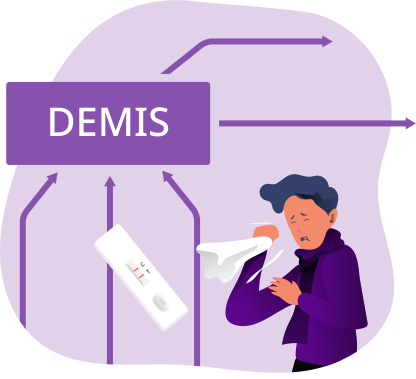
With electronic patient records, interoperable data formats, and AI-assisted report communication, what is changing most is the form in which this expertise becomes visible and usable. The laboratory report of the future is no longer merely a static document — it can be more structured, audience-specific, interactive, and more deeply embedded in digital care processes.
For laboratories, this represents a significant opportunity: existing clinical quality can be communicated more effectively, represented more cleanly in primary systems, and made more accessible to different audiences.
The foundation remains: analytics, pre-analytics, and clinical assessment
However much presentation, language, and interaction evolve, the basis of a good laboratory report remains unchanged. What matters is rigorous pre-analytics, validated measurement methods, transparent methodology, correct reference ranges, and clinically sound interpretation.
AI can help make information easier to understand, structure report content, or generate different forms of communication. But it does not replace laboratory medicine expertise. In laboratory medicine especially, interpretation depends on many details: sample material, collection time, measurement method, interferences, prior results, cut-offs, plausibility rules, local SOPs, and clinical context.
The next development step therefore does not lie in fundamentally reinventing laboratory reports. Rather, it is about making existing clinical quality even more useful: more precisely structured, more clearly expressed, more transparently reasoned, and more closely linked to relevant next steps.
The temporal dimension matters here too. Measured values remain documented results at a specific point in time. Their interpretation, however, may change as new clinical information becomes available, relevant prior results emerge, or guidelines and scientific evidence evolve. Modern report communication should reflect this dynamic — without calling the reliability of the original report into question.
Interoperability: the report must work where it is needed
A modern laboratory report must not only be readable by people. It should also be capable of being structured, standardised, and interoperably integrated into digital workflows.
This begins with statutory and regulatory requirements — particularly in the context of electronic patient records, structured laboratory reports, and standardised exchange formats. In practice, this means laboratory reports must be cleanly representable in primary systems: in LIS, HIS, practice management, or GP systems, as well as in patient record contexts, with health insurers, and in due course within wider patient-facing digital ecosystems.
This may also include, where medically appropriate and compliant with data protection requirements, offerings from health insurers, preventive care platforms, health apps, or fitness ecosystems. Particularly in the areas of prevention, lifestyle medicine, monitoring, or chronic disease management, it can be genuinely valuable for patients to receive laboratory information not merely as a PDF, but in a form that can be meaningfully reused.
Interoperability is therefore more than a technical matter. It determines whether a report can become part of a workflow: for longitudinal analysis, reminders, risk indicators, reflex ordering, preventive recommendations, clinical queries, or targeted preparation for further diagnostics.
One report — multiple perspectives
A laboratory report is used by different audiences. The clinical content remains the same, but language, level of detail, and presentation may vary depending on the recipient.
Clinicians need: medical precision, result patterns, reference logic, prior results, methodology, guidance on possible next diagnostic steps, and information on differential diagnosis, clinical course, methodological considerations, and clinical implications.
Patients need: orientation around the key questions: What was tested? What does the result mean? Is anything abnormal? What should be discussed with the treating clinician? A patient-friendly view can explain the same content in accessible language, make uncertainties transparent, and avoid unnecessary anxiety.
Multilingual and plain-language formats: Different language versions, plain language, or audience-specific explanatory variants can help make medical information more accessible to a wider range of recipients.
Core principle: Communicative simplification must not lead to clinical oversimplification. The medical meaning must remain consistent, even when it is presented differently for different audiences.
Interactive: lab reports as part of a dialogue
The traditional laboratory report is often a closed document: analysis performed, result validated, report delivered. In many cases, that remains entirely appropriate. In other situations, however, the report can increasingly serve as the starting point for a structured dialogue.
An interactive report can offer targeted support to both patients and clinicians. Patients might, for instance, add further information about symptoms, exposure, medication, medical history, or the timeline of events. Clinicians could more quickly absorb relevant findings, ask targeted follow-up questions, or identify supplementary diagnostics. The laboratory can make its interpretive role more visible and better connect report content to the original clinical question.
This added value is particularly tangible in allergy diagnostics. A result gains considerably in significance when connected to symptoms, triggers, exposure situations, and clinical course. An interactive allergy report can therefore offer more than a simple display of individual IgE values: it can explain relationships, present findings in a patient-friendly way, and prompt relevant follow-up questions in a structured manner.
Interactivity does not mean that patients should make clinical decisions independently. Quite the contrary: good digital report communication should improve the flow of information between the laboratory, treating clinicians, and patients. Possibilities include context-sensitive queries within the report, views with varying levels of detail, expandable explanatory sections, printable summaries, or structured follow-up actions.
Not every report requires its own app. For one-off results, a web view or a well-structured digital report may be entirely sufficient. Where recurring value arises — for example in chronic conditions, prevention, monitoring, allergies, or risk profiling — accompanying portals or integrated patient views can, however, provide genuine benefit.
Actionable: reports should provide guidance on the next step
A good laboratory report does not only explain what was measured. It also helps in understanding what the sensible next step is.
For this, communication must relate to the original clinical question. Was a value measured as part of exclusion diagnostics? Was the aim therapy monitoring, longitudinal tracking, prevention, or investigation of specific symptoms? The same measurement may be relevant in different ways depending on the question. Modern report communication should take this context more fully into account.
“Actionable” does not mean the report replaces therapeutic decisions. It means that information is presented in a way that is oriented towards action: a recommendation to consult a clinician, a note on follow-up monitoring, a suggestion for supplementary diagnostics, structured reflex ordering, a preventive recommendation, or preparation for a clinical consultation.
This is precisely where one of laboratory medicine’s strengths lies. Reflex strategies, diagnostic pathways, and rule-based reflex ordering have been established elements of high-quality laboratory processes for many years. AI-assisted communication can complement these existing strengths by aggregating context, making content more accessible, and presenting relevant information in an audience-specific way.
Integrative: laboratory values gain meaning through context
Many laboratory values only reveal their significance in context. A single value may appear unremarkable, even when the trend over time is clinically relevant. Conversely, an isolated abnormal value may be less urgent when considered within the clinical picture. Modern report communication should therefore, where appropriate and permissible, integrate additional information: symptoms, relevant prior results, medication, clinical history, the clinical question, or longitudinal data.
The aim is not maximum data collection, but better contextualisation. An allergological result becomes more meaningful when symptoms and exposure are taken into account. A renal value gains in significance when the trend is visible. Therapeutic drug monitoring can barely be meaningfully assessed without reference to timing, dose, interactions, and target ranges. Specialist diagnostics frequently requires domain expertise, local reference logic, and clear process rules.
This is precisely where it becomes clear why generic explanations alone are insufficient. The right report communication requires a combination of structured data, laboratory medicine knowledge, local rule and reference logic, and high-quality language. AI can help to better connect these layers — particularly for aggregation, summarisation, translation, and patient-friendly presentation.
The sensible approach is therefore hybrid: global AI capabilities for language, structuring, and synthesis, combined with local medical intelligence, validated rules, curated sources, laboratory expertise, and clear governance.
Evidence and transparency
The more reports are explained, contextualised, and presented in an action-oriented way, the more important evidence and transparency become. Patients and clinicians must be able to understand what an interpretation is based on: measured values, reference ranges, prior results, clinical guidelines, validated rule sets, local SOPs, or curated specialist knowledge.
This is especially critical in AI-assisted report communication. Systems should not merely generate plausible text — they must communicate medically validated information consistently and transparently. This requires clear source attribution, versioning, audit logging, approval mechanisms, and human accountability at the right points.
Again, the same principle applies: AI is not a substitute for laboratory medicine assessment. But it can help to make existing expertise more scalable, more accessible, and more readily connected to clinical workflows.
Conclusion
The laboratory report of the future is interoperable, clinically robust, audience-specific, interactive, and action-oriented. It builds on what laboratories already deliver today: precise analytics, quality-assured processes, clinical interpretation, and advisory support across clinical questions.
What is new, above all, is that this quality can be made even more visible and usable within digital care processes. Reports can be represented more cleanly in primary systems, explained more clearly to patients, provided in multiple languages, enriched with symptoms and prior results, and more closely connected to meaningful next steps.
For laboratories, this is not a diminishment of their existing role — it is an extension of their impact. Laboratory medicine expertise remains the foundation. Modern data standards, interactive report formats, and AI-assisted communication can help bring that expertise more effectively to where it is needed: to clinicians, patients, digital care systems, and in due course to preventive and patient-facing ecosystems too.
Ultimately, this is not about making laboratory values look more attractive. It is about transforming clinically sound reports into better communication, better guidance, and better processes. That is one of the most important steps forward in modern laboratory software.