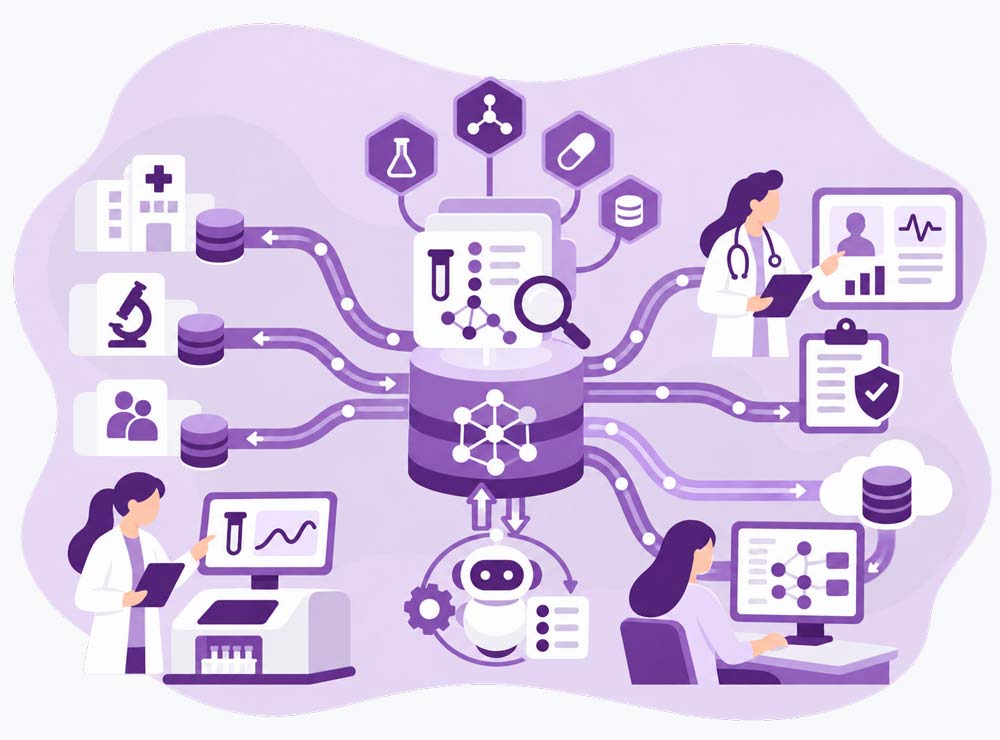
Over recent years, hospitals have invested heavily in their digital infrastructure. Hospital information systems, laboratory information systems, electronic patient records and specialist applications now support many clinical processes.
However, information is still often spread across different systems and presented as individual data points. Clinicians must therefore frequently interpret current results, previous measurements, medication records and diagnoses themselves.
This becomes particularly challenging when multiple findings need to be assessed together, changes over time must be identified, clinical guidelines need to be considered or diagnostic steps must be coordinated across different departments.
The real value of digitalisation increasingly lies in bridging the gap between the data available and the clinical decision.
From Displaying Information to Supporting Decisions
Diagnostic Intelligence adds another layer to existing hospital IT. Rather than simply displaying information, it analyses clinical data in context, identifying relationships between current findings, previous results and diagnostic pathways.
For example, a system might flag a combination of laboratory results that warrants further investigation, identify a test that was performed recently or highlight an important diagnostic step that has yet to be completed.
The aim is not to replace clinical judgement, but to make relevant information available precisely where it is needed.
To achieve this, medicalvalues combines existing clinical data with structured medical knowledge and defined diagnostic pathways. This enables decision support to promote guideline-based diagnostic processes while taking the individual patient context into account.
What Does This Mean for Hospitals in Practice?
The benefits become particularly clear when Diagnostic Intelligence is integrated directly into existing clinical workflows.
Less Time Spent Searching for Information
Clinicians often need to switch between systems, review previous findings and manually reconstruct diagnostic histories.
Bringing relevant information together and interpreting it in context can reduce the time spent on these manual tasks.
The goal is simple: less time searching for information and more time putting it to clinical use.
More Consistent Diagnostic Processes
Clinical guidelines and internal standard operating procedures (SOPs) provide important guidance. However, applying them consistently in day-to-day clinical practice is not always easy, particularly in complex cases or under time pressure.
Digital decision support can translate these requirements into structured diagnostic pathways and make them available within existing workflows. This helps hospitals achieve greater consistency without replacing individual clinical decisions with rigid processes.
Avoiding Unnecessary or Duplicate Testing
More testing does not automatically mean better testing. Investigations are sometimes repeated because previous results are difficult to find or the clinical context is not immediately apparent.
Intelligent order and decision support can take existing findings into account, identify potential duplicate requests and suggest appropriate next diagnostic steps. This benefits not only clinical teams, but also laboratories and other diagnostic departments.
Identifying Relevant Changes Earlier
An individual measurement often provides only limited insight. What matters clinically may be the trend over time: a rising inflammatory marker, deteriorating kidney function or a combination of results that becomes significant only when assessed together.
Structured analysis of existing data can help make these developments visible earlier, allowing diagnostic information to be used more effectively in inpatient care.
Standardisation Without Losing Clinical Flexibility
Hospitals are complex organisations, with different departments, workflows, local standards and patient populations. Effective clinical decision support therefore cannot rely on a single universal algorithm.
Instead, standardised medical knowledge must be combined with local requirements. Diagnostic Intelligence can, for example, bring together clinical guidelines, hospital-specific SOPs and diagnostic standards.
This creates a shared foundation for more consistent diagnostic processes while preserving specialist requirements and established hospital workflows.
Integration Matters as Much as Intelligence
Even the most advanced medical algorithm offers limited value if clinicians have to open another application, re-enter data or manually transfer results between systems.
Diagnostic Intelligence should therefore form part of the existing IT landscape. Standards such as HL7, FHIR, LOINC and SNOMED CT support the exchange of medical information between systems while helping to preserve its meaning across different applications.
medicalvalues therefore combines clinical decision support with interoperability: existing information should be connected and made more useful, rather than creating another isolated data silo.
The Real Value Lies in the Clinical Workflow
Hospital digitalisation often focuses on individual technologies, from artificial intelligence and structured data to Clinical Decision Support.
For hospitals, however, the most important consideration is the practical impact on day-to-day work:
-
Does the solution save clinicians time?
-
Does it help them identify relevant information more quickly?
-
Does it make diagnostic processes more consistent?
-
Does it reduce avoidable manual tasks?
-
Can it be integrated into existing systems and workflows?
When clinical data is combined with medical knowledge and embedded directly into existing workflows, hospitals can make much more effective use of the information they already have to support diagnostic decisions.
Ultimately, the goal is not to generate even more data.
It is to make better use of the data already available.